
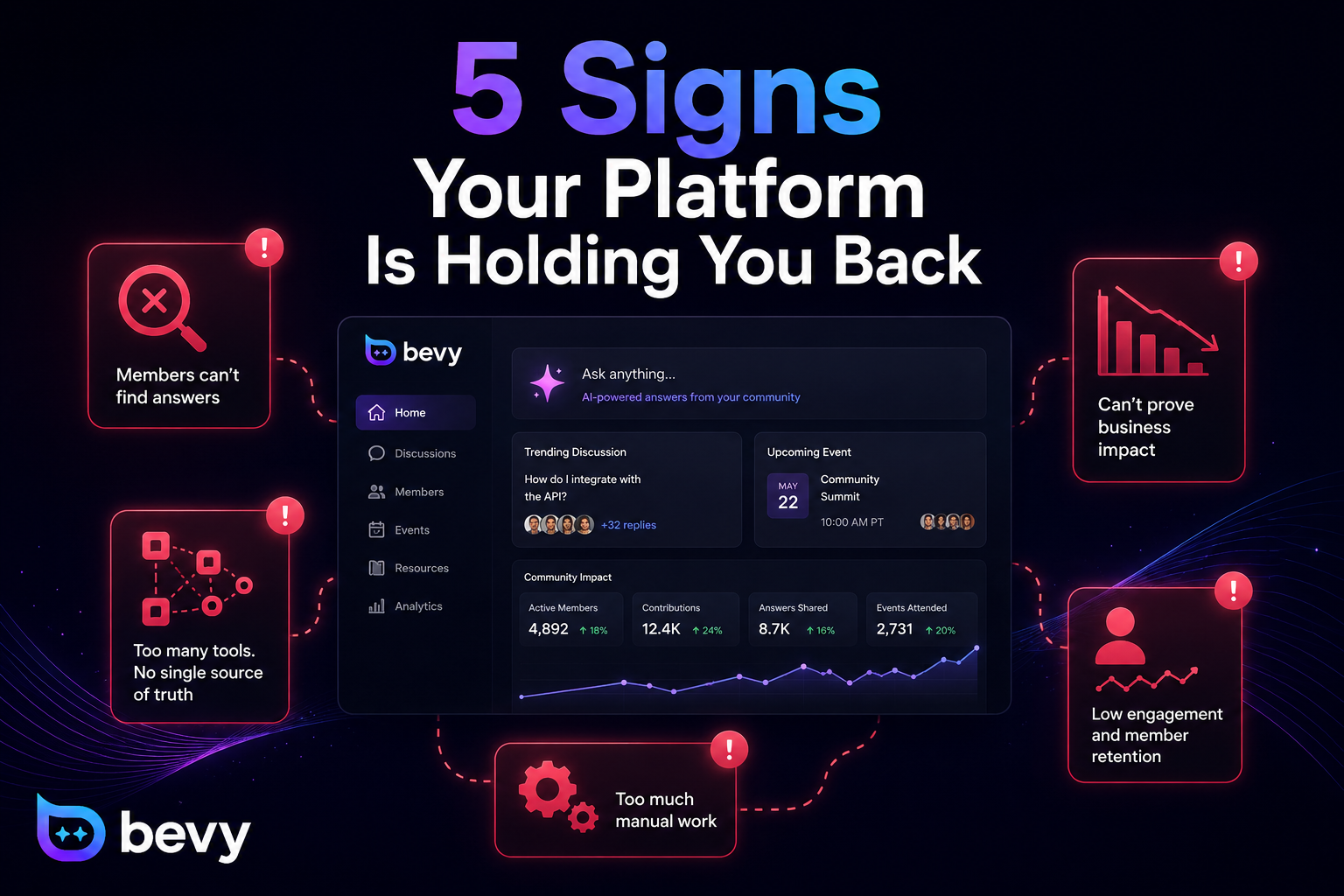
5 Signs Your Community Platform Is Holding Your Program Back
If your community program feels like it has plateaued, the problem may not be your strategy, your team, or your members. It may be your platform. According to the CMX Community Industry Report 2025, which surveyed over 800 community professionals across industries, 58% of community professionals say their current platform limits their ability to execute their community strategy. That is not a small gap. That is the majority of enterprise community programs running below their potential because the tool underneath them was not built for what they need to do today.
Platform limitations are easy to rationalize. Teams adapt. Workarounds become habits. The friction becomes background noise. But there is a real cost: buried knowledge, manual processes that consume hours that should go toward member engagement, metrics that cannot connect to business outcomes, and a member experience that does not reflect the quality of the program it is supposed to support.
This article identifies five specific signs that your community platform is the constraint. Each sign is a symptom of a broader architectural problem in first-generation community tools, and recognizing them is the first step toward understanding what your program actually needs from a modern platform.
Sign 1: Your Members Cannot Find Answers on Their Own
The most visible failure mode of an aging community platform is a search experience that does not work. Members post questions that have already been answered dozens of times in existing threads. Valuable knowledge is buried three pages deep in a forum category no one navigates to. When members cannot find answers quickly, one of two things happens: they open a support ticket, or they disengage.
This is not a moderation problem or a content problem. It is a platform problem. Legacy community tools were built on keyword-matching search, which requires members to use exactly the right terms to surface relevant results. They do not synthesize information across multiple threads, summarize what the community already knows, or surface the most relevant answer based on context. As a community grows, the knowledge it holds becomes harder to access, not easier.
Modern community platforms include AI-powered knowledge search that generates answers from community content directly. A member asking a question gets a synthesized response drawn from relevant discussions and resources, not a list of loosely related threads to scroll through. According to Gartner's 2025 Hype Cycle for Customer Service and Support Technologies, AI-augmented community platforms are now clearly differentiated from legacy platforms that rely on keyword search alone, and Gartner recommends that organizations evaluating community technology prioritize platforms with native AI capabilities.
If your community holds real expertise but your members consistently cannot access it, the platform is the bottleneck. The knowledge is there. The architecture is failing to surface it.
Sign 2: You Are Managing Multiple Tools to Run One Community Program
How many platforms does it take to run your community? If the answer is more than one, you are already operating at a structural disadvantage.
Most enterprise community programs have expanded to include forums for discussion, a separate tool for virtual and in-person events, a messaging platform for real-time community conversations, and one or more reporting tools for tracking engagement. Each tool has its own member database. Each generates its own data. None of them talk to each other the way your members experience the community as a single whole.
The CMX Community Industry Report 2025 found that 54% of community professionals manage their programs using three or more separate tools, and only 18% report using a unified community platform. This fragmentation creates three compounding problems. First, the member experience is inconsistent. Members navigate between separate surfaces with different logins, different UX patterns, and no continuity. Second, the community team spends significant time on tool management rather than member engagement. And third, it becomes impossible to build a unified view of how individual members are engaging across all community activities, which undermines any attempt to measure community impact.
According to research from Productiv's 2025 enterprise SaaS management report, 43% of enterprises report that tool fragmentation is a top-three barrier to building a unified view of customer engagement. Community programs face this problem in a concentrated form because community inherently spans multiple types of interaction: discussion, events, knowledge sharing, recognition, and relationship building. When these are distributed across separate platforms, no single view of the community exists.
Sign 3: Running Your Community Requires More Manual Work Than It Should
Think about the operational tasks that consume your community team's time each week. How much of it is work that should be automated but is not? Manually reviewing new posts for moderation. Re-announcing upcoming events across different channels because your event tool does not connect to your forum. Compiling engagement data from separate platforms into a report for leadership. Reaching out individually to inactive members because there is no automated re-engagement capability. Creating welcome posts for new members because there is no onboarding workflow.
This manual overhead is the direct result of running a community program on a platform that was built before automation and AI were viable parts of the stack. It is not a staffing problem. It is an architecture problem.
The CMX Community Industry Report 2025 found that 68% of community teams operate with three or fewer people. Small teams managing large programs cannot afford to spend a third of their week on tasks that a modern platform would handle automatically. The Microsoft Work Trend Index 2025 found that operational teams, including customer engagement roles, saw a 2.3x increase in AI tool adoption year-over-year, driven largely by teams seeking to reclaim time from repetitive manual tasks.
Modern community platforms address this through AI engagement agents that automate specific operational functions: surfacing trending content for moderation review, matching members with similar interests or questions, generating engagement prompts, and flagging shifts in community sentiment. When these capabilities are native to the platform, community teams can focus on strategic relationship-building and program development rather than administrative overhead.
If your team is consistently stretched thin not because your community is too demanding but because too much of what it demands is manual, your platform is the constraint.
Sign 4: You Cannot Connect Community Activity to Business Outcomes
If someone in your leadership team asked you today how your community is contributing to customer retention, product adoption, or support cost reduction, how confident would you be in your answer?
For most community leaders running on legacy platforms, the honest answer is: not very. According to the CMX Community Industry Report 2025, 62% of community professionals say proving ROI is their number one challenge. That is not because community does not drive business outcomes. Research from The Community Roundtable's 2025 State of Community Management report found that community teams with CRM-connected community data are 2.7 times more likely to report positive executive perception of community value. The problem is that legacy platforms do not connect community activity to the systems where business outcomes are tracked.
A first-generation community forum tracks posts, likes, and logins. It does not tell you whether the members most active in your community have lower churn rates than those who never engage. It does not show you whether product questions answered in community reduce support ticket volume. It does not integrate with your CRM to surface which community-active accounts are expanding versus at risk. These are the connections that transform community from a program that feels valuable into one that demonstrably is.
IDC's 2025 market analysis of the digital community platform space describes this as a defining characteristic of mature community platforms: the ability to connect community engagement data to business outcomes through CRM integrations, engagement analytics, and data export. IDC categorizes platforms without this capability as Tier 1 or Tier 2 and estimates that approximately 65% of enterprise communities are still operating at these tiers.
Sign 5: Member Adoption Is Lower Than You Know Your Community Deserves
Your community has valuable content. Your team has invested significant time in building programs, seeding discussions, and creating events. But your member adoption numbers tell a different story. A large percentage of registered members never return after their first visit. Event registration does not convert to attendance. Active contributors are a small fraction of the total membership. New members join and disappear.
It is tempting to attribute this to the content, the programming, or the audience. But consistently low adoption is often a signal that the member experience itself is the barrier. If your platform presents members with a cluttered interface, a search function that does not surface relevant content, no personalized onboarding, no recognition for participation, and no reason to come back because there is no feed or notification system that surfaces what matters to them, then low adoption is a predictable outcome of poor UX, not evidence that your community content lacks value.
The Community Roundtable's 2025 State of Community Management report found that the highest-maturity community programs, those that demonstrate measurable business impact, are four times more likely to have strong platform capabilities as one of the four pillars of their program architecture. Platform capability is not a nice-to-have in the maturity model. It is a structural requirement for achieving the outcomes that community programs are built to deliver.
Modern community platforms address member adoption through multiple mechanisms: personalized onboarding flows that connect new members to relevant content and other members immediately, gamification systems that recognize and reward contribution, notification and digest systems that bring relevant discussions to members rather than requiring them to seek content out, and event experiences that are fully integrated with the community rather than existing as separate destinations. AI-powered knowledge search also plays a role in adoption: when members find value quickly in their first interactions, they return.
If your member adoption numbers are consistently below your expectations and below what you know your content and programming should deliver, your platform's member experience architecture is worth examining as a root cause.
How Many of These Signs Apply to Your Program?
Each of the five signs in this article points to a different dimension of community platform limitations. But they rarely appear in isolation. A platform that lacks AI knowledge search is usually also the platform that lacks analytics integration and native engagement automation. These are symptoms of the same underlying architecture: a tool built for a support forum model that assumes community is primarily about storing and categorizing text, not about driving engagement, surfacing knowledge intelligently, enabling a small team to operate at scale, and connecting participation to business outcomes.
IDC estimates that approximately 65% of enterprise communities are currently running on first-generation or limited platforms. If your program shows three or more of the signs above, your platform is very likely the constraint on your community's growth, not your strategy and not your team.
Frequently Asked Questions
How do I know if my community platform is outdated? There are five common signs that a community platform is limiting program growth. Members struggle to find answers because knowledge is buried across disconnected tools and a weak search experience. Running the community requires too much manual work because the platform lacks automation. Community data cannot be connected to business outcomes like retention or support deflection. The platform lacks AI capabilities for knowledge search or automated engagement. And member adoption is consistently lower than the quality of the program should produce. If a community team recognizes three or more of these symptoms, the platform itself is likely the constraint.
What are the most common problems with legacy community platforms? Legacy community platforms were built for a support forum model and typically lack four capabilities that modern enterprise community programs require. First, AI-powered knowledge search that synthesizes answers from community content rather than relying on keyword matching. Second, a unified architecture that handles forums, events, and user group management in a single system. Third, analytics that connect community engagement to business outcomes through CRM integration. Fourth, AI-driven engagement tools that allow small teams to manage large communities without excessive manual overhead. According to CMX's 2025 Community Industry Report, 54% of community professionals currently manage their programs across three or more separate tools, which is a direct consequence of legacy platforms not being able to handle the full scope of a modern community program.
Why is community tool fragmentation a problem for enterprise teams? Community tool fragmentation forces enterprise teams to manage member experiences across multiple disconnected systems. This creates three compounding problems. The member experience is inconsistent, with members navigating between separate surfaces with different logins and UX patterns. Community teams spend significant time on tool management rather than member engagement. And it becomes impossible to build a unified view of how individual members engage across all community activities, which makes measuring community ROI nearly impossible. Productiv's 2025 enterprise SaaS management report found that 43% of enterprises say tool fragmentation is a top-three barrier to building a unified view of customer engagement.
What happens when community knowledge is buried in old forum threads? When community knowledge is buried in hard-to-search forum threads, members cannot find answers on their own. This drives two negative outcomes. Members open support tickets instead of resolving questions through community self-service, which increases support costs. And members disengage from the community because they do not find value in early interactions. Over time, the community's most experienced contributors also feel less motivated to answer questions if they know their answers will be just as hard to find as the questions themselves. Gartner's 2025 Hype Cycle for Customer Service and Support Technologies specifically identifies AI-native knowledge synthesis as a key differentiator between modern and legacy community platforms for this reason.
Can an outdated community platform hurt member engagement? Yes. An outdated community platform directly reduces member engagement through several mechanisms: poor search UX that prevents members from finding relevant content, lack of personalized onboarding that connects new members to what matters to them, no gamification or recognition system to incentivize contribution, and no AI-driven engagement tools to surface relevant discussions to members who are not actively searching. The Community Roundtable's 2025 State of Community Management report found that the highest-maturity community programs are four times more likely to demonstrate measurable business impact and that strong platform capability is one of four structural pillars of program maturity.
When should an enterprise community team start evaluating new platforms? An enterprise community team should begin a platform evaluation when they recognize multiple signs that their current platform is constraining program growth: consistently low member adoption despite strong programming, inability to connect community data to business outcomes, excessive manual operational overhead, knowledge that is difficult for members to find, and community activities spread across multiple disconnected tools. The CMX Community Industry Report 2025 found that 58% of community professionals already feel their platform limits their strategy execution.
See What a Modern Community Platform Can Do
If you recognized your program in the signs above, the next step is defining what to look for in a replacement. Reach out to us and we can help you craft what those requirements should be.