
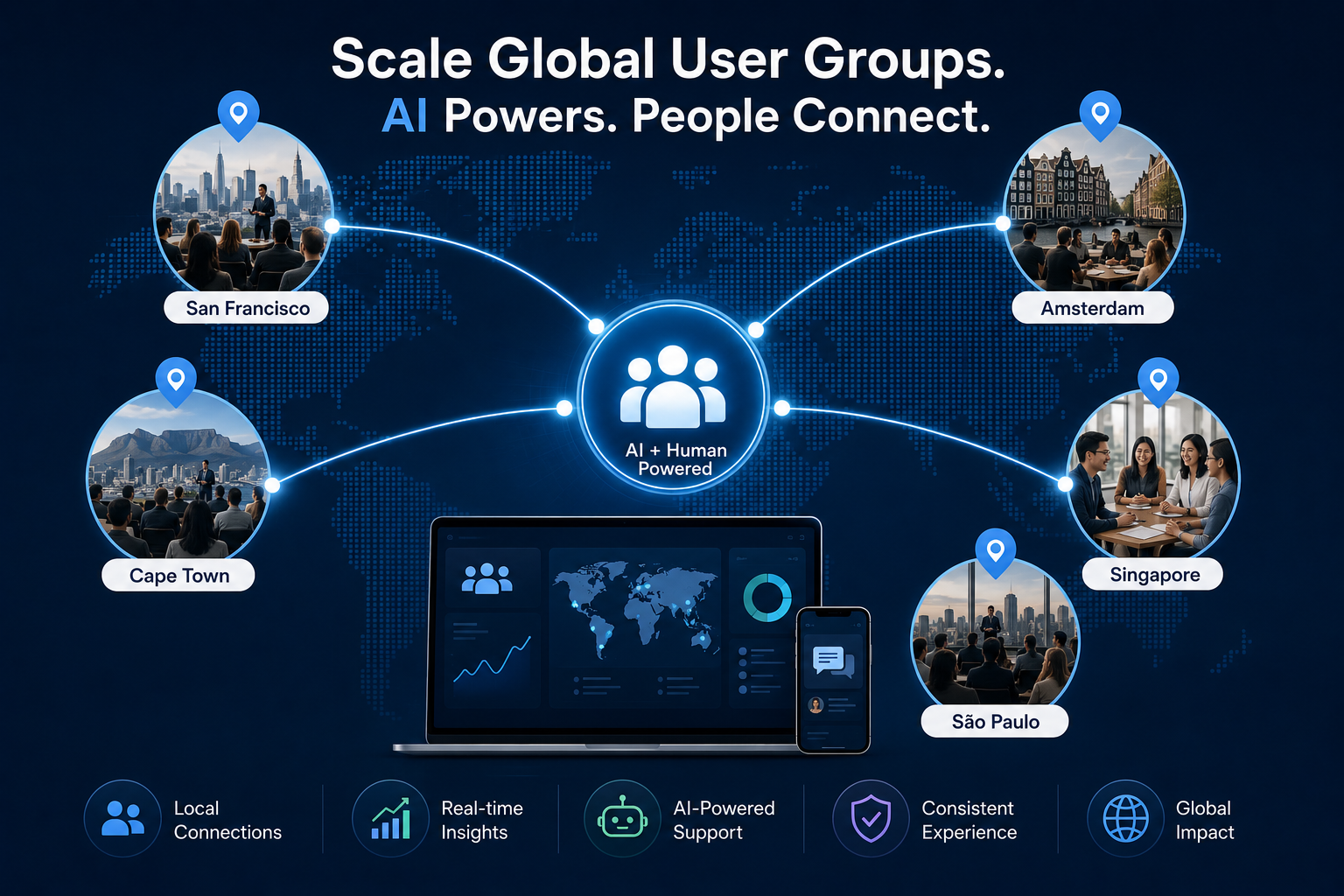
Scaling Global User Groups in the AI Era: What Enterprise Brands Get Right
Running a single community event well is hard. Running twenty regional user groups across four continents consistently is a different challenge entirely.
Enterprise community programs that have scaled global user group networks share a common operational pattern. They have learned, usually through experience, that you cannot manage a global chapter program the way you manage a single community. The variables multiply: chapter leader quality varies, regional attendance patterns differ, time zones complicate communications, and cultural norms around professional networking are not uniform. What works in San Francisco does not automatically translate to Singapore or Amsterdam.
At the same time, the business case for scaling user groups globally is compelling. Jono Bacon, author of "People Powered" and a community strategy consultant, has written from his consulting work with enterprise clients that community programs with active chapter networks retain members at materially higher rates than programs without them. The relationship between local, human-led events and long-term community membership is one of the most consistent findings in community strategy. Regional user groups create the peer relationships, shared identity, and sense of belonging that sustain loyalty in ways that digital engagement alone cannot.
The operational challenge is not whether to scale user groups globally. It is how to do it without the program collapsing under its own weight or fragmenting into a collection of inconsistently run local events that share a name but not a standard.
AI changes what is possible here. Not by replacing the human elements that make user groups valuable, but by handling the operational complexity that previously required either large central teams or acceptance of inconsistent program quality. The enterprise community programs getting this right in 2026 are using AI to manage the scale layer and investing their human team's energy in the connection layer. This post examines what that model looks like in practice.
Direct answer: Enterprise companies scale community user groups globally by combining a centralized operations layer with empowered local chapter leaders. The central community team sets program standards, provides content and speaker resources, manages the technology platform, and tracks performance analytics. Local chapter leaders handle event planning, member engagement, and relationship building in their region. AI tools support scaling by automating member matching, surfacing engagement analytics across chapters, moderating discussions, and identifying chapters that need attention. This model allows a small central team to support dozens or hundreds of regional user groups without proportional headcount growth.
Why Global User Group Programs Break Down
Before examining what enterprise brands do well, it is useful to understand the common failure patterns. Most programs that attempt to scale globally run into the same set of problems.
The first is chapter leader dependency. User group programs at the regional level depend almost entirely on the quality and commitment of the local chapter leader. A motivated, well-supported chapter leader can build a thriving local community from a standing start. A disengaged or under-supported chapter leader can let a chapter with fifty interested members produce zero events for six months. When the program has ten chapters, this is manageable through personal attention from the central team. When it has sixty chapters, personal attention does not scale. Chapter quality becomes inconsistent, members in underserved regions have a materially worse experience than members in well-run chapters, and the program's brand suffers.
The second problem is central team bandwidth. A community team that is handling sixty chapters across multiple time zones, each with its own event calendar, communication needs, and operational requirements, will quickly find that operational management crowds out everything else. The central team ends up spending most of its time on administrative logistics: approving event pages, sending reminder templates, troubleshooting registration issues, and chasing chapter leaders for activity updates. There is no time left for the strategic work that would actually improve program quality: coaching chapter leaders, developing content resources, analyzing engagement trends, and building the practices that make the program better over time.
The third problem is visibility gaps. Without good data on chapter performance, the central team is flying blind. They may not know that a chapter in one city has been inactive for three months until a member complains. They may not see that a chapter in another city has grown its attendance by 60% and could benefit from additional resources and recognition. The absence of real-time visibility into chapter health makes it impossible to intervene proactively or to allocate central team attention where it will have the most impact.
AI addresses all three of these failure patterns, though in different ways and to different degrees. Understanding which problems AI solves and which problems still require human judgment is the starting point for building a program that scales.
The Centralized-Plus-Local Model
The structural foundation of every global user group program that works at scale is a clear division between what is managed centrally and what is owned locally. This is not a new idea, but AI makes it significantly more executable than it was even two or three years ago.
The central team is responsible for the platform, the program standards, the content resources, and the data. They own the technology that chapter leaders use to create event pages, manage registrations, and communicate with members. They set the standards for what a quality user group event looks like: the format guidelines, the branding requirements, the speaker sourcing criteria, and the member experience expectations. They create and maintain the content library that chapter leaders draw from: presentation templates, event format playbooks, onboarding materials for new members, and facilitator guides for different event types. And they own the data layer that tracks chapter health, member engagement, and program performance across all regions.
Local chapter leaders own the execution, the relationships, and the community experience in their region. They decide which event format fits their local membership, who the right speakers are for their audience, and how to build the specific community culture that will attract and retain members in their city or region. They are the human face of the program for members in their region. Their quality as relationship builders, their knowledge of the local professional community, and their commitment to the program are the primary determinants of whether the chapter thrives.
The central-plus-local model works when the central team provides enough support that chapter leaders can focus on what they are actually good at, and when the central team has enough visibility into chapter performance to direct attention and resources where they are needed. AI makes both of those conditions more achievable.
How AI Supports the Central Operations Layer
For the central team, AI addresses the bandwidth problem directly. The high-volume, repetitive administrative work that previously consumed central team capacity can now be handled with meaningful AI support.
Member matching and chapter onboarding. When a new member joins the broader community, connecting them to their nearest local chapter is an obvious first step, but doing it manually across thousands of new members is not feasible. An AI introductions agent can identify the relevant chapter for a new member based on their location and interests, send a personalized introduction to the chapter leader and the new member, and handle the initial onboarding communication. The chapter leader receives a warm introduction rather than a cold name on a list. The new member feels welcomed into a specific local community rather than dropped into a generic member database. This happens automatically, at scale, without central team intervention for each individual.
Chapter health monitoring and early warning. With AI analytics surfacing engagement data across all chapters, the central team can see at a glance which chapters are performing well and which need attention. A chapter that has not hosted an event in ninety days, whose chapter leader has not logged into the platform in sixty days, or whose member engagement scores have declined significantly over the past quarter is a chapter that needs proactive intervention. Without AI analytics, the central team might not notice until a member raises a concern. With AI surfacing these signals automatically, the central team can reach out to the chapter leader early, understand what is happening, and decide whether to offer support, coaching, additional resources, or in some cases, a change of leadership.
Moderation and content standards across chapters. Large user group programs generate significant discussion activity across dozens of chapter forums and event-related communications. Maintaining content quality and community guidelines across all of that activity manually is not realistic. AI moderation agents handle routine content review, flag policy issues, and maintain community standards across all chapters simultaneously. The central team handles edge cases and sets the moderation policy. The chapters maintain consistent standards without requiring the central team to review every post.
Communications and event promotion. AI content creation agents can generate event promotion drafts based on the details a chapter leader enters for their event, reducing the writing burden on chapter leaders who may not be professional communicators. The central team reviews and approves, but the drafting work is reduced. For member communications like post-event recaps and upcoming event reminders, AI can handle routine generation so chapter leaders can spend their time on the event itself rather than the surrounding communications.
Together, these AI capabilities mean that a central team of three or four people can maintain meaningful visibility and support across a program of fifty or more chapters, without each team member being personally responsible for tracking every chapter's status through manual reporting and individual follow-up.
How Human Energy Goes to Chapter Leader Development
The central team capacity that AI creates should not be absorbed by other administrative work. It should be directed toward the single highest-leverage activity in a global user group program: developing and supporting the chapter leaders who are the human engine of the program.
This is where the "AI for knowledge, events for connection" framework introduced in Why Community Events Matter More in the AI Era, Not Less applies most directly to user group programs. The AI layer handles the knowledge and operational scale. The human team handles the connection and development layer. Both are necessary. The connection layer is what makes the difference between a program that runs and a program that thrives.
What does investing in chapter leader development actually look like in practice?
Regular one-on-one conversations between central team members and chapter leaders. Not status updates about registration numbers, but genuine professional development conversations. What is working in their chapter? What is the hardest part of the job? What resources or training would help them run better events? What do they see happening in their local professional community that the central program should know about? These conversations build the relationship between the central team and the chapter leader, and they surface insights about the program that data alone will never reveal.
Chapter leader cohorts and peer learning. One of the most valuable and underutilized resources in a global user group program is the collective experience of the chapter leaders themselves. A chapter leader in London who has figured out how to drive consistent attendance to evening events has knowledge that would be directly useful to a chapter leader in Chicago struggling with the same problem. Creating structured opportunities for chapter leaders to learn from each other, through a chapter leader community, a regular cohort call, or an annual in-person chapter leader summit, compounds the program's learning faster than anything the central team can teach directly.
Recognizing and advancing strong chapter leaders. The chapter leaders who do this well are providing significant value to the community program and to the company. They are volunteers or lightly compensated contributors who are managing meaningful professional development programs for customers in their region. Recognizing their contributions publicly, giving them access to exclusive resources or company experiences, and creating pathways for the strongest chapter leaders to take on broader program roles or advisory relationships converts good chapter leaders into long-term program advocates.
Removing friction from the event execution process. The central team's job is to make it as easy as possible for chapter leaders to run a high-quality event. Every unnecessary step in the event creation process, every approval workflow that creates a delay, and every resource that is hard to find or customize is a reason for a chapter leader to reduce their event frequency or eventually disengage. The central team should continuously audit the event creation and execution process from the chapter leader's perspective and remove obstacles. AI can reduce some of this friction directly (auto-generating event promotion copy, for example). Process design removes the rest.
MIT Sloan Management Review research on community social capital found that the strength of a community depends on both the network of relationships among members and the quality of the facilitation that creates opportunities for those relationships to form. For global user group programs, the chapter leader is the primary facilitator. Investing in the chapter leader's capabilities, support, and satisfaction with the program is the highest-leverage input the central team controls.
Maintaining Quality Across Regions
One of the central tensions in scaling a global user group program is the tradeoff between consistency and local relevance. A program that enforces rigid uniformity across all chapters will sacrifice the local authenticity that makes user groups valuable in the first place. A program that allows complete local autonomy will produce inconsistent quality that undermines the overall program brand.
The programs that navigate this well tend to operate with what might be called a "standards with flexibility" approach. Certain things are non-negotiable and consistent across all chapters: the community platform used for event management, the branding and naming conventions, the member privacy and data practices, and the core community values and conduct standards. These are the standards that define the program and protect its integrity.
Within those standards, chapter leaders have significant latitude to adapt to their local context. The event format, the frequency, the venue type, the speaker mix, the networking structure, and the cultural tone of the events are all decisions that chapter leaders make based on what works for their membership. A chapter in Tokyo may run highly structured, content-heavy sessions. A chapter in Austin may favor informal roundtable discussions over dinner. Both are valid expressions of the same program, and both should be allowed to succeed on their own terms.
AI supports this balance in a specific way. By giving the central team visibility into performance across all chapters, AI analytics makes it possible to identify which local variations are working and share them across the program. When the data shows that one chapter's event format is consistently generating higher post-event community engagement, the central team can document that approach, add it to the program's content library, and make it available to other chapter leaders as an option to try. The program improves through evidence-based sharing rather than top-down mandates.
David Spinks, founder of CMX and a Bevy advisor, has written about the importance of what he calls "community minimum viable experience," the baseline quality of experience that every community member should receive regardless of which chapter or region they belong to. Defining that minimum and using data to monitor whether all chapters are meeting it is exactly the role that AI analytics can play in a global program. The central team focuses on closing gaps in minimum viable experience. The program's ceiling is raised by learning from and spreading the practices of the chapters that are exceeding the minimum.
Connecting User Group Programs to Business Outcomes
The measurement framework for global user group programs builds directly on the four-category model described in Measuring the Business Impact of Community Events: A Framework for 2026. Retention, product adoption, advocacy, and pipeline influence all apply at the chapter level as well as the program level.
At scale, a global user group program needs to measure at two levels. The program level tracks aggregate impact: overall retention lift for event attendees across all chapters, total influenced pipeline from user group contacts, program-wide advocacy conversion rates. These are the numbers that justify the program's existence and budget in an enterprise review.
The chapter level tracks individual chapter health and relative performance. Chapters with strong attendance trends, high post-event engagement lift, and members who become program advocates are healthy chapters. Chapters with declining attendance, low member engagement, and little advocacy activity are chapters that need intervention. The ability to compare chapter performance and identify leading and lagging chapters is what allows the central team to direct their human energy toward the chapters where it will have the most impact.
Forrester research indicates that customers who attend community events retain at materially higher rates than non-attendees. For an enterprise program with user groups in twenty cities, that retention lift, tracked consistently across chapters and compared to the cohort of customers in those regions who did not attend, becomes a powerful and recurring data point for justifying the program's investment. Combined with advocacy data and pipeline influence metrics, it builds a business case that connects regional events to the outcomes that leadership uses to evaluate customer programs.
The data infrastructure requirements are the same as for any event program: event attendees tagged in the CRM, attendance data connected to customer records, and a consistent reporting cadence that surfaces the comparisons between event attendees and matched non-attendees. The additional requirement for global programs is that the data is segmented by chapter so the central team can see regional patterns alongside aggregate program performance.
What Enterprise Brands Get Right
The enterprise community programs that succeed at global scale share several practices that distinguish them from programs that struggle.
They treat chapter leaders as partners, not volunteers. The most successful programs invest meaningfully in chapter leader development, recognition, and support. They create a community of chapter leaders alongside the member community. They celebrate chapter leader contributions publicly. They give chapter leaders access to company leadership and product teams in ways that reinforce the value of the role. Chapter leaders who feel genuinely valued and supported run better events and stay in the role longer.
They let AI handle what AI is good at and protect human time for what matters. The programs that get into operational trouble are often the ones that under-invest in AI capabilities and allow the central team to be consumed by administrative work, or that over-automate and lose the human relationships that make chapter programs distinctive. The right balance is clear in principle: AI for scale, humans for connection.
They measure outcomes, not just activity. The best programs know their retention lift per event, their advocacy conversion rate for chapter members versus non-chapter members, and their influenced pipeline from user group contacts. They present these numbers to leadership quarterly. They use the data to make resource allocation decisions about which chapters to invest in and which event formats to prioritize.
They design for the long term. A global user group program is not a marketing campaign with a beginning and an end. It is a community infrastructure investment. The programs that deliver the most business value over time are the ones that approach chapter development, content resources, chapter leader relationships, and data infrastructure as ongoing investments rather than one-time launches.
The AI for knowledge, events for connection framework that runs through this entire campaign applies at full scale to global user group programs. The AI layer makes the program manageable. The human layer makes the program meaningful. Both are required. Enterprise community leaders who build programs that deliver both will have user group networks that competitors cannot replicate, because the human relationships at the local level are not a technology feature. They are a community asset that compounds over time.
Frequently Asked Questions
How do enterprise companies scale community user groups globally? Enterprise companies scale community user groups globally by combining a centralized operations layer with empowered local chapter leaders. The central community team sets program standards, provides content and speaker resources, manages the technology platform, and tracks performance analytics across all chapters. Local chapter leaders handle event planning, member engagement, and relationship building in their region. AI tools support scaling by automating member matching to local chapters, surfacing engagement analytics across the program, moderating discussions, and flagging chapters that need central team attention. This model allows a small central team to support dozens or hundreds of regional user groups without requiring proportional headcount growth.
What is the role of AI in managing user group programs? AI plays a primarily operational role in global user group programs. It handles member matching so new members are automatically connected to their nearest chapter, surfaces analytics that give the central team visibility into chapter health and performance across all regions, supports moderation of chapter discussions, and assists with content generation for event promotion and post-event recaps. AI does not replace the chapter leader or the relationship-building work that makes user groups valuable. It reduces the administrative burden on the central team so they can focus on chapter leader development, quality improvement, and the human elements of the program that AI cannot handle.
How many chapters or user groups can a small community team manage? A small community team of three to five people can support a significantly larger number of chapters when AI tools are handling the operational layer. Without AI support, a team of three is typically managing somewhere between ten and twenty chapters before quality begins to suffer. With AI tools handling member matching, engagement monitoring, moderation, and routine communications, the same team can maintain meaningful visibility and support across fifty or more chapters, provided the chapter leaders are empowered to handle local execution and the central team focuses its human energy on chapter leader development and quality oversight rather than operational administration.
What makes a successful enterprise user group program? Successful enterprise user group programs share several characteristics: a clear program structure with defined roles for the central team and chapter leaders, consistent branding and quality standards across regions with room for local adaptation, a technology platform that supports event management and member engagement in one system, real-time data visibility into chapter health and member engagement, meaningful investment in chapter leader development and recognition, and a consistent measurement practice that connects user group participation to business outcomes including retention, product adoption, and advocacy. The most effective programs treat user groups as a strategic community asset rather than as a discretionary marketing activity.
How do you maintain quality in community events across multiple regions? Maintaining consistent quality across regional user group chapters requires a "standards with flexibility" approach. The central team sets non-negotiable standards: the community platform, branding, conduct policies, and minimum quality expectations for member experience. Within those standards, chapter leaders have latitude to adapt event format, frequency, and style to their local context. AI analytics help the central team monitor whether all chapters are meeting minimum quality thresholds and identify which chapters need support. Best practices from high-performing chapters are documented and shared across the program so the overall program quality improves over time through evidence-based learning rather than top-down mandates.
See How Bevy Supports Global User Group Programs
Bevy is built for enterprise community programs that need to manage global chapter and user group networks without proportional headcount growth. The platform combines global chapter and user group management, AI engagement agents that handle the operational layer, gamification tools that reward event attendance and chapter participation, and an analytics layer that gives your central team visibility across every chapter in the program. If you are building or scaling a global user group program, we would like to show you how it works.