
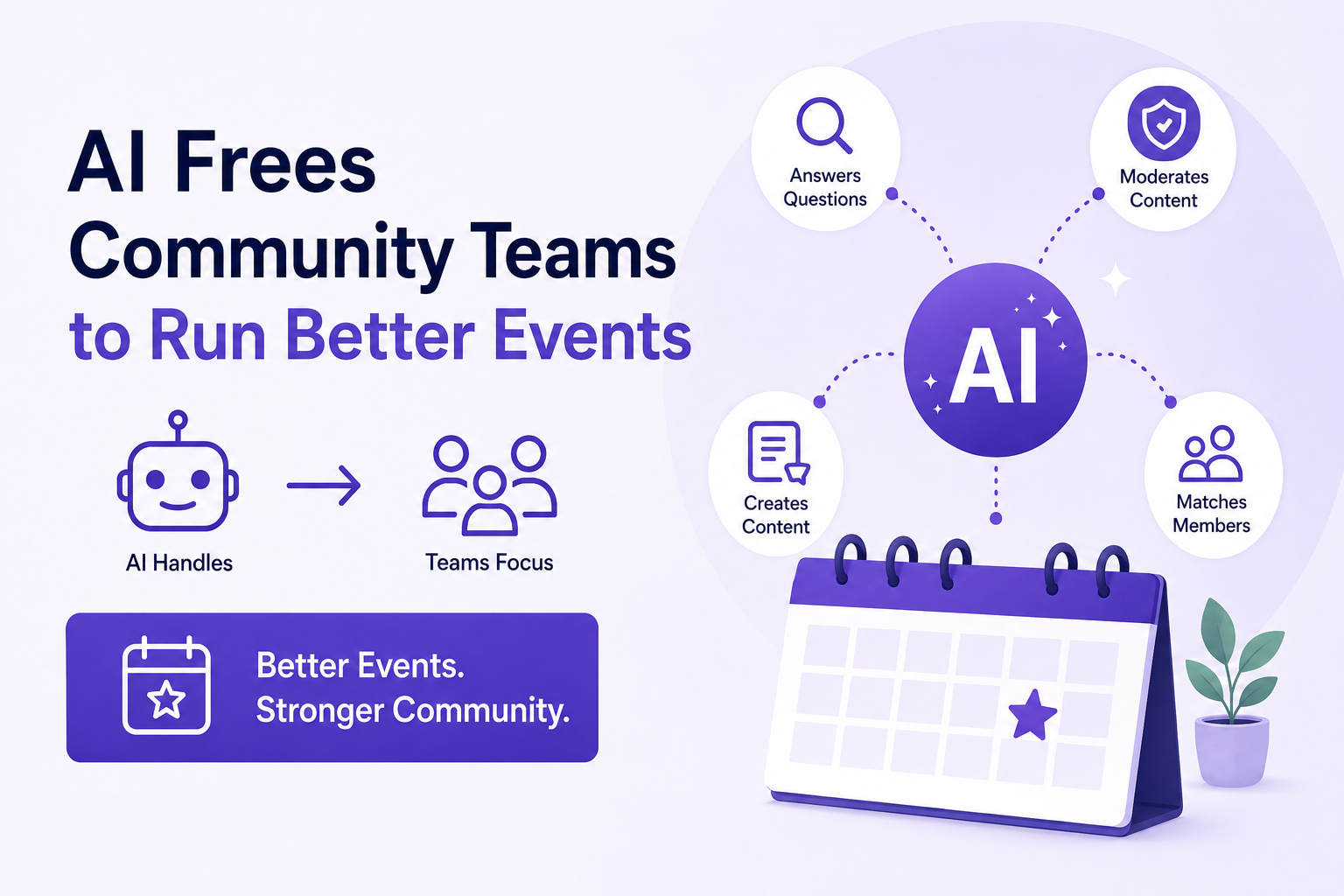
How AI Frees Community Teams to Run Better Events
Most enterprise community programs run on small teams. According to the CMX Community Industry Report, published by Bevy's CMX community, the majority of community programs are managed by teams of one to three people, regardless of how large the community itself has grown. A single community manager might be responsible for moderating discussions, answering member questions, creating content, managing event logistics, onboarding new members, and reporting on engagement metrics. All at once. Every week.
That is not a staffing problem unique to any one organization. It is the structural reality of community management as a profession. And it means that how a community team allocates its time is one of the most consequential decisions they make.
AI changes that calculation. Not by replacing community teams, but by absorbing the high-volume, repeatable tasks that currently consume the majority of their working hours. When AI handles moderation, Q&A, content surfacing, and member matching, the community team gets something genuinely valuable back: time and focus. The question is what they do with it.
The answer, for community programs that want to drive retention, advocacy, and measurable business outcomes, is events. This post explains how AI creates the operational capacity for community teams to invest in high-quality events, and why that investment delivers the outcomes that matter most to enterprise organizations.
Direct answer: AI helps community teams run better events by automating routine operational tasks that consume the majority of a community manager's time. When AI tools handle content moderation, answer common member questions through knowledge search, surface relevant discussions, and match members with shared interests, community teams can redirect their time toward high-value work: designing event programming, recruiting speakers, developing regional chapter strategies, and creating attendee experiences that build lasting relationships. AI does not replace the community team. It frees the team to focus on the work that AI cannot do.
Where Community Team Time Actually Goes
Before examining how AI changes the picture, it is worth being honest about where community team time currently goes in most enterprise programs.
Moderation is the most time-intensive routine task for the majority of community managers. Reviewing posts, removing spam, enforcing community guidelines, and de-escalating conflict in discussions requires constant attention in an active community. In large communities with thousands of posts per month, this alone can consume a meaningful portion of a community manager's week.
Answering questions is the second major time sink. Many community managers spend significant hours each week responding to member questions, especially technical or product-related questions that require thoughtful answers. A significant portion of those questions are ones that have been answered before. The answer exists somewhere in the community archives, but members do not always find it, and community managers end up answering the same questions repeatedly.
Content and communications add another layer. Writing newsletters, drafting announcements, creating onboarding sequences for new members, and maintaining a steady stream of discussion prompts and educational content is ongoing work that does not have a natural stopping point. Then there is the administrative layer of event management: creating event pages, managing registrations, sending reminders, coordinating speakers, and following up with attendees after the fact.
Taken together, these tasks represent the operational baseline of running a community program. They are necessary. They are not, however, where a community team creates the most value. The work that drives retention, advocacy, and business outcomes, designing programs that create genuine human connection, requires creative judgment, relationship-building skills, and strategic thinking that no amount of routine task completion can substitute for.
AI does not eliminate the need for community teams. It eliminates the need for community teams to spend the majority of their time on work that does not require them.
What AI Actually Handles
The term "AI for community management" covers a range of capabilities that vary significantly in how much time they genuinely save. It is worth being specific about what AI can do well and where it makes the largest operational difference.
AI Knowledge Search is among the highest-impact capabilities for reducing community team workload. When members ask questions, AI Knowledge Search synthesizes answers from existing community content, forum threads, event discussions, and documentation, and surfaces a relevant response without requiring a team member to find and write it. For a community where hundreds of members ask questions each month, many of them similar or identical to questions asked before, this capability alone can reclaim hours of community manager time each week. It also improves the member experience: members get faster answers, and the community's accumulated knowledge becomes genuinely searchable rather than buried in threads.
AI Moderation removes the need for manual review of every post and comment. An AI moderation agent can flag content that violates community guidelines, identify spam, surface posts that need human review, and manage the routine compliance layer of community governance. The community manager still makes final decisions on edge cases and handles situations that require human judgment. But the volume of content requiring manual attention drops significantly, and the community manager is no longer spending time reviewing posts that clearly comply with guidelines.
AI Engagement Agents cover a broader set of operational tasks. A content creation agent can generate discussion prompts, event summaries, and weekly digests. An introductions agent can match new members with existing members who share similar roles or interests, so that new member onboarding does not depend on a community manager personally connecting each new arrival to the right people. A gamification agent can track participation, award points and badges, and recognize top contributors without manual administration. A sentiment agent can surface emerging themes or signs of member dissatisfaction before they become larger problems, giving the community team early signals to act on rather than issues to react to.
Together, these capabilities do not automate away the community manager's job. They automate away the parts of the job that were already the least interesting and the least strategic: the repetitive, reactive, high-volume work that accumulates regardless of how well the community is actually performing.
The Time That AI Creates
When a community manager is no longer spending three hours a day moderating discussions and answering recurring questions, what does that time become available for?
The most valuable use of that recovered time, from a business outcome perspective, is event programming and user group development. These are the activities that require exactly the skills AI does not have: the ability to recruit and brief a compelling speaker, to understand what a regional group of customers needs to get out of a meetup, to design a workshop agenda that generates real learning and real relationships, to follow up with a chapter leader who is struggling to build attendance in their city.
Jono Bacon, author of "People Powered" and a widely recognized community strategy consultant, has written from his consulting experience with enterprise clients that community programs with active event and user group components retain members at rates materially higher than programs without them. His argument is that the operational complexity of running a strong event program is one of the main reasons more community teams do not invest in it adequately. When the community manager is already at capacity handling the day-to-day digital operations, events become the first thing deprioritized.
AI changes the capacity equation. When the operational layer is running with meaningful AI support, a community manager who was previously at capacity can now allocate time to event programming without dropping anything important. A user group manager can focus on chapter leader development and regional event quality rather than spending mornings moderating forum discussions. An events manager can spend more time on speaker experience and attendee follow-up rather than manually processing registrations and sending individual reminders.
This is the practical translation of the "AI for knowledge, events for connection" framework introduced in Why Community Events Matter More in the AI Era, Not Less. AI handles the knowledge layer efficiently. The team's human energy goes to the connection layer. The result is a community that is both well-run and genuinely engaging.
What Better Events Actually Look Like
It is worth being concrete about what a community team does with the capacity AI creates, because "better events" can sound abstract.
A community team that has recovered meaningful time from AI-handled operations can invest in event quality in several specific ways.
Speaker recruitment and preparation improves. Identifying the right speakers, briefing them well, helping them tailor their content to the specific audience in a given city or vertical, and following up afterward to build an ongoing relationship: this takes time that most community managers do not have when they are at operational capacity. With AI handling routine tasks, that time becomes available. The result is events with higher-quality programming and speakers who feel genuinely supported rather than processed through a logistics workflow.
Chapter leader development becomes sustainable. For enterprise programs running global user group networks, the quality of the community depends heavily on the quality of the local chapter leaders who organize regional events. Supporting those leaders, providing them with content resources, coaching them on event facilitation, connecting them with each other so they can share what works: this is high-value relationship work that cannot be automated. When the central community team has operational capacity, they can invest in chapter leader relationships at a depth that makes the whole program stronger.
Post-event follow-through happens consistently. One of the most common gaps in enterprise community event programs is the space between the event itself and what happens afterward. Attendees leave an event energized, and then receive nothing from the community for two weeks. The relationship momentum dissipates. With AI handling ongoing community communications and member matching, the community team can focus on the post-event window: sending a personalized follow-up, creating an event recap that surfaces the most valuable insights, connecting attendees who expressed similar interests, and channeling the energy of the event back into the online community. MIT Sloan Management Review research on community social capital found that in-person event attendance significantly increased subsequent online community participation. Capturing that increase requires follow-through that only the human team can provide.
Event strategy improves. When community managers are not in reactive mode, they can think ahead. They can analyze which event formats and locations generated the strongest post-event engagement, which topics drove the highest attendance, and which attendees became the most active community members after an event. They can build an event calendar that tells a coherent story across the year rather than responding to whatever requests and opportunities arise. AI analytics can surface the underlying engagement data. The community manager decides what it means and what to do with it.
The Right Balance for Enterprise Community Programs
There is a version of the AI-in-community conversation that frames automation as the goal. The argument goes: if AI can handle more and more of community management, the team can shrink, costs can come down, and the program becomes more efficient.
That framing gets the logic backwards. The goal of using AI in a community program is not to reduce the team. It is to increase what the team can accomplish. A community of ten thousand enterprise customers managed by a team of three, where AI handles the operational layer and the team focuses on events and relationship building, will consistently outperform the same community managed by a team of six where everyone is stuck in operational mode.
Gartner research on customer experience programs has found that organizations using a blended model combining AI-mediated engagement with intentional human-led interactions report meaningfully higher customer satisfaction than those relying primarily on automated engagement. The research points to a threshold beyond which more automation produces diminishing and eventually negative returns on customer relationships. Events and human-led community programming are the counterbalance that keeps community programs on the right side of that threshold.
For enterprise community leaders, the practical implication is clear. Invest in AI capabilities that reduce operational burden on the community team. Then direct that freed capacity toward building the event and user group programs that drive retention, advocacy, and the kind of member relationships that show up in renewal rates and expansion revenue. These are not competing priorities. They are two components of the same strategy.
Frequently Asked Questions
How can AI help community teams run better events? AI helps community teams run better events by automating routine operational tasks that consume the majority of a community manager's time. AI tools can handle content moderation, answer common member questions through knowledge search, surface relevant discussions, and match members with shared interests. When these tasks are handled by AI, community teams can redirect their time toward high-value work: designing event programming, recruiting speakers, developing regional chapter strategies, and creating attendee experiences that build lasting relationships.
What community management tasks can AI automate? AI can automate several core community management tasks, including moderating discussions for policy compliance, answering frequently asked questions using AI knowledge search across community content, generating content summaries and event digests, matching members based on interests or profiles, sending onboarding sequences for new members, and tracking engagement patterns. These tasks are repetitive and time-intensive when handled manually. AI automation does not replace the community team. It frees the team to focus on strategic and relational work like events, user groups, and member advocacy programs.
How do small community teams manage events at scale? Small community teams manage events at scale by combining AI tools for operational efficiency with a clear investment of human time in event quality and chapter leader development. AI handles the high-volume, routine layer of community management so the team is not at perpetual operational capacity. The human team focuses on the work that requires judgment and relationship skills: speaker recruitment, chapter leader coaching, event design, and post-event follow-through. For global user group programs, empowering strong local chapter leaders and supporting them with centralized resources allows a small central team to support events across many regions without proportional headcount growth.
What are AI engagement agents for community programs? AI engagement agents are purpose-built tools within a community platform that automate specific types of member engagement. Examples include a moderation agent that flags policy-violating content, a knowledge agent that surfaces answers from community content when members ask questions, an introductions agent that matches new members with relevant existing members, a content creation agent that generates discussion prompts and event recaps, and a gamification agent that tracks contributions and awards recognition. Together, these agents handle the operational engagement layer of community management so the human team can focus on programming and relationship building.
How does AI moderation free up time for community managers? AI moderation removes the need for community managers to manually review every post and comment in an active community. An AI moderation agent continuously monitors community discussions, flags content that may violate guidelines, filters spam, and surfaces posts that require human judgment. Community managers still handle edge cases and set moderation policy, but the volume of content requiring manual attention drops significantly. In communities with high posting volume, this can reclaim a substantial portion of the community manager's time each week.
What is the best way to balance AI automation and human-led events? The most effective approach is a clear division of responsibility based on what each layer does best. Use AI for the knowledge and operational layer: answering questions through AI-powered knowledge search, moderating discussions, generating content, matching members, and analyzing engagement trends. Invest human time and budget in the connection layer: designing and running events, building user group programs, recruiting and supporting chapter leaders, and creating the experiences that build trust and lasting relationships. The goal is not to balance AI and events as competing priorities but to let each do what it does best, so the community program delivers both operational efficiency and genuine member engagement.
See How Bevy Combines AI and Events in One Platform
Bevy is the enterprise community platform that unifies AI engagement agents, AI knowledge search, and a full enterprise event and user group management system in one place. If you want to see how community teams use Bevy to run leaner operations and higher-impact events, we are happy to walk you through it.